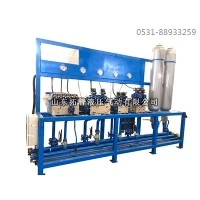
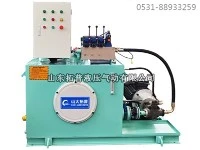
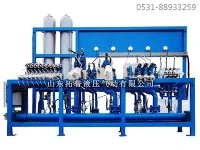
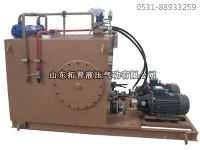
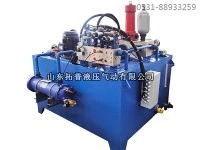
An electro-hydraulic servo system is a type of feedback control system primarily composed of an electrical signal processing unit and a hydraulic power mechanism. The typical components of such a system are as follows:
(1) Command element. This provides the input signal; it can be a mechanical device (such as a cam or linkage) providing a displacement signal, or an electrical component (such as a potentiometer) providing a voltage signal.
(2) Feedback sensing element. This detects the actual output of the actuating element and converts it into a feedback signal. It can be a mechanical device (such as a gear pair or linkage) or an electrical component (such as a potentiometer or tachogenerator).
(3) Comparison element. This compares the command signal with the feedback signal to generate an error signal. In practice, there is usually no dedicated comparison element; instead, this function is performed by one of the other structural components.
(4) Amplification and conversion element. This amplifies the error signal derived from the comparison element and converts it into an electrical or hydraulic signal (pressure or flow). Examples include electronic amplifiers and electro-hydraulic servo valves.
(5) Actuating element. This converts hydraulic energy into mechanical energy to produce linear or rotary motion, directly controlling the object under control. It typically refers to a hydraulic cylinder or hydraulic motor.
(6) Controlled object. This refers to the system load, such as a machine table.
The six parts listed above constitute the basic components of a hydraulic servo system. Additionally, compensation elements may be added to improve system performance, and proportional elements may be included to scale the input signal.
Aug 11, 2026
Composition Of Electro-hydraulic Servo Systems
Send Inquiry
Product Categories
Latest Products